

Top 10 NBA Point Guards in History
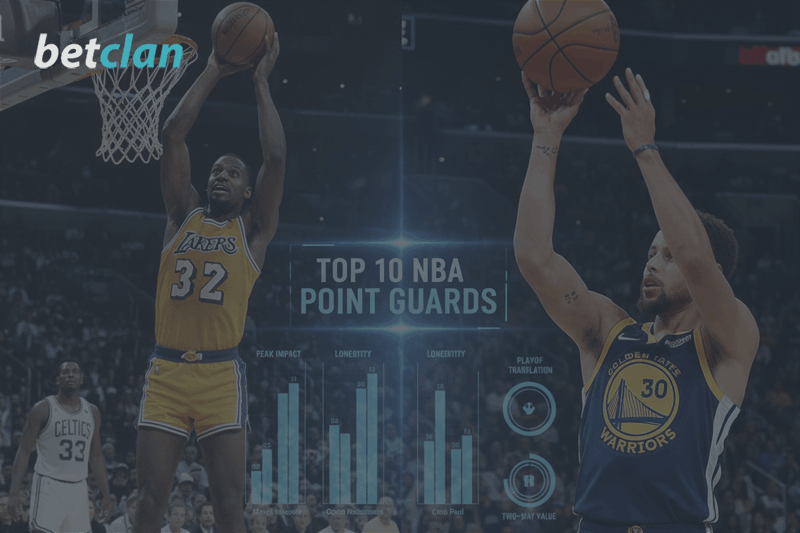
A deep, criteria based breakdown of the 10 greatest NBA point guards ever, with era context, peak and longevity analysis, playoff translation, leadership impact, and modern fit for each legend.
How Greatness Is Evaluated for Point Guards
Ranking point guards across NBA history is more complex than comparing raw totals. The position has been redefined multiple times by changes in rules, spacing, pace, defensive schemes, and the evolution of shot creation. A guard in the 1960s often played in tighter spacing with different dribbling enforcement and more set based offense. A guard in the 2000s faced hand checking variations, heavier pick and roll usage, and defensive coverages designed to punish weak decision makers. Today’s point guards are asked to combine playmaking with spacing gravity, high volume shot creation, and defensive survivability in switching environments.
To keep this ranking professional and consistent, the list prioritizes five pillars. First is peak impact: how overwhelming the player was at their best, especially against elite opponents. Second is longevity: how many seasons they maintained top tier influence as a primary initiator. Third is playoff translation: whether their strengths held up when teams had time to scout and scheme. Fourth is two way value and lineup scalability: whether they could function across roster types and avoid becoming a defensive target. Fifth is leadership and orchestration: not narrative, but the real ability to stabilize possessions, raise teammate efficiency, and control game tempo in high leverage minutes.
There will always be reasonable disagreements, especially in the middle of the top 10 where different philosophies produce different orders. This ranking aims to be coherent, era aware, and rooted in how point guards actually drive winning at the highest level.
1) Magic Johnson
Magic Johnson is the most complete offensive organizer the position has ever seen when you blend playmaking scale, efficiency, matchup pressure, and big game performance. His size changed the geometry of passing lanes and mismatch creation. He did not simply run an offense, he expanded what the offense could be.
Peak dominance and control
At his peak, Magic could tilt a series through pace and decision making. He punished traps with vision over the top, turned rebounds into instant transition, and controlled half court possessions with timing rather than speed. The key point is that his value did not depend on one action. If teams switched, he could post. If they blitzed, he hit the release pass and the chain reaction followed. If they stayed home, he created layups through manipulation.
Playoff translation
Magic’s value increased in playoff environments because he created high quality shots without needing to “win” on isolation. His style is naturally resistant to variance, because it is built on advantages that repeat: early offense, mismatches, and elite passing windows.
Modern fit
With today’s spacing, Magic would likely produce even more efficient team offense. Four shooters around him would punish help. Switching defenses would create more post mismatches and more corner three creation. His defense would still need scheme support in certain matchups, but his size and intelligence translate well to modern team concepts.
2) Stephen Curry
Stephen Curry is the most influential offensive point guard of the modern era because he changed how defenses must behave. His shooting is not only accuracy, it is gravity. That gravity reshapes spacing, help rules, and transition priorities for the opponent.
What makes Curry unique
Curry’s greatest advantage is that he creates offense without the ball as much as with it. His relocations, quick releases, and willingness to sprint into actions force constant defensive communication. That creates mistakes. Those mistakes become layups, open threes, and easy cuts. In a professional evaluation, that is elite scalable offense because it lifts teammates without requiring them to be secondary stars.
Playoff translation
High level defenses can reduce certain shots, but they cannot remove the structural stress Curry creates. Even when he does not shoot, the threat forces overhelp and opens short roll creation. That is why his best teams generated elite offense even in postseason series against top defenses.
Modern fit
He is the modern fit. Curry is a blueprint that changed roster building. Teams began prioritizing shooting, movement, and decision speed because the alternative was falling behind strategically.
3) Oscar Robertson
Oscar Robertson was an early model of the power initiator: a primary creator who could score, pass, and physically impose advantages. He carried heavy offensive responsibility in an era where spacing and pace differed dramatically, yet his profile still maps to modern heliocentric engines.
Complete offensive package
Robertson combined strong shot creation with advanced playmaking instincts. He could get to spots, punish smaller guards, and maintain efficiency through strength and touch. His best seasons showed the value of a guard who can function as both lead scorer and lead passer.
Era translation and value
While modern efficiency metrics are shaped by three point volume, Robertson’s core strengths are timeless: manipulation, patience, and the ability to generate a good shot late in the clock. In modern spacing, his downhill pressure and passing would likely be even more punishing.
4) Chris Paul
Chris Paul is one of the most technically complete point guards ever. If the question is “who played the position with the highest level of precision for the longest time,” Paul belongs near the top of any serious list.
Pick and roll mastery
Paul consistently created efficient offense through reads rather than force. He punished defenders who went under with pull ups, punished drop coverage with midrange accuracy, and punished blitzes by hitting the short roll or the corner on time. His advantage creation is repeatable, which is why his teams almost always overperformed expectations in the regular season.
Two way impact
Paul’s defense is built on anticipation, positioning, and disruption. He is not a big guard, but he understands angles and timing. In playoff settings, that matters because point guards can be hunted. Paul’s awareness reduced that vulnerability, even when size disadvantages existed.
Playoff context
While championship narratives often dominate casual rankings, a professional evaluation should also value sustained elite influence and game control. Paul’s playoff record includes both strong runs and frustrating injuries, but his level of play in high leverage games is historically elite.
5) John Stockton
John Stockton is the standard for long term playmaking consistency and possession efficiency. His durability, decision discipline, and defensive activity created value that compounded over decades.
Why Stockton ranks this high
Stockton generated offense without wasting possessions. He rarely forced low percentage shots, consistently created efficient looks for teammates, and excelled in structured half court play. His chemistry in the pick and roll is a case study in timing, not just volume passing.
Defense and playoff reliability
Stockton was a high IQ defender with quick hands and strong team positioning. In the postseason, his style translated because it did not rely on streaky shot making. His teams could expect stable creation and low turnover orchestration.
6) Isiah Thomas
Isiah Thomas embodies playoff toughness and high leverage creation. He was a smaller guard who routinely attacked elite defenses and delivered in environments where physicality and pressure were extreme.
Late game creation
Thomas could generate offense when playbooks collapsed. He created separation, finished creatively, and made difficult shots when defenses knew exactly what was coming. This is a major separator for all time guards: the ability to produce quality offense late in playoff games against set defenses.
Leadership and identity
Point guard leadership is real when it changes execution quality. Thomas helped define a team identity built on resilience and cohesion. He also adjusted his scoring and playmaking balance based on opponent and series needs.
7) Steve Nash
Steve Nash is one of the greatest offensive conductors ever, especially in terms of raising team efficiency. His blend of shooting, passing creativity, and tempo management produced elite offenses that look even more modern today.
Decision speed and spacing logic
Nash created advantages by arriving early to the correct read. He manipulated help defenders with body orientation, then punished the smallest mistake with a pass that generated a high value shot. His shooting threat mattered, because it forced defenders to stay attached and opened the lane for his passing angles.
Modern fit
In today’s NBA, Nash would likely take more threes, which would increase his scoring impact without reducing his playmaking. His style is a natural match for modern pace and space principles.
For readers tracking contemporary matchups, pace, injuries, and form, a simple reference some fans use alongside film and analytics is Basketball Predictions to compare how current styles and roster contexts can influence outcomes.
8) Jason Kidd
Jason Kidd’s all time value is built on two elite traits: passing that fuels transition and defense that scales. He made teams more organized, more physical, and more dangerous in open floor basketball.
Transition engine
Kidd rebounded like a forward and immediately converted stops into advantage. That matters because transition points are among the most efficient points in basketball. His hit ahead passing and ability to push tempo without turning the ball over created a constant pressure that opponents had to respect.
Defensive scalability
In playoff contexts, weak defenders get targeted. Kidd was not that. He could guard multiple perimeter types, survive switches, and use size and instincts to disrupt actions. That defensive value increases his portability across eras.
9) Walt Frazier
Walt Frazier is one of the best two way point guards in league history, combining championship level floor control with elite perimeter defense. His game deserves modern respect because it aligns with what elite teams demand from guards: creation without chaos and defense without compromise.
Two way excellence
Frazier’s defense was not about gambles. It was about posture, timing, and intelligent pressure. Offensively, he could score efficiently, pass with purpose, and control tempo in big games.
Legacy
Frazier helped define what a winning point guard looks like when both ends matter. In a modern setting, he would likely be viewed as the kind of guard contenders build around because he does not create structural weaknesses.
10) Bob Cousy
Bob Cousy makes the list for historical influence and high level playmaking that expanded what the position could be. He helped establish the point guard as a creative driver of offense, not merely a ball deliverer.
Innovation and precedent
Cousy’s creativity shaped expectations for ball-handling and passing. The league’s skills ecosystem evolved, and part of that evolution was driven by early stars who made flair and invention acceptable, then normal, then required.
Era context
Rules and spacing were dramatically different, so direct stat comparison is not the point. The point is positional impact: Cousy helped define the role that later legends refined.
Honorable Mentions
Several greats narrowly miss the top 10 depending on how a ranking weights peak versus longevity or offense versus defense. Jerry West often enters point guard discussions despite role variations. Gary Payton has a strong two way argument. Allen Iverson redefined volume creation and cultural influence. Russell Westbrook’s athletic pressure and playmaking produced elite peaks. Damian Lillard is one of the best clutch shot makers and deep range threats ever. These names matter, and in a different criteria set, some could enter the 8 to 10 range.
What the Greatest Point Guards Share
They create repeatable advantages
Championship basketball is about actions that work when opponents are prepared. The best point guards generate reliable offense through spacing gravity, timing, decision speed, and late game shot creation.
They scale across teammates and systems
True greats remain effective whether they play with a dominant big, multiple shooters, or a defense first roster. Their value is not fragile. It travels.
They survive postseason targeting
In the playoffs, opponents hunt weaknesses. The guards on this list either held up defensively, or were so offensively dominant that teams could build schemes to protect them without losing identity.
Final Thoughts
The best point guards are not just stat producers. They are the architecture of winning. They dictate pace, structure possessions, and create the highest value shots when the margin is smallest. Magic sits at the top because he combined size driven matchup leverage with unmatched orchestration. Curry sits near the top because he changed the geometry of the sport. The rest of this list reflects different eras and different solutions to the same challenge: how to create efficient offense, control games, and translate impact into postseason wins. Point guard greatness is ultimately about control under pressure, and these 10 names represent the strongest long term evidence of that control in NBA history.
Discover the 10 most iconic NBA MVP winners of the last 20 years, with analysis of the impact, legacy, and importance of each player.
Discover the best strategies and tips for eSports betting. Learn how to analyze teams, players, and games to increase your chances of success in online betting.
Explore the best volleyball spikes of all time, from iconic power hitters to modern aerial stars, and discover the attacks that changed matches, tournaments and the history of volleyball.
Discover the Advantages and Disadvantages of Live and Pre-game Betting in the World of Sports Betting. Learn How to Choose the Right Strategy to Maximize Your Winnings.
In this comprehensive guide, we delve into the enthralling world of NFL betting. Beginning with an extensive overview of the league and its highlights, including the thrilling Super Bowl LVII, we dive deep into effective betting strategies, tips, and crucial analyses to turn your passion for American football into profitable ventures.
Discover how to improve your hockey bets through in-depth analysis of players and teams. This comprehensive guide offers valuable insights for bettors looking to maximize their chances of success.
Discover effective strategies and essential tips for making money with sports betting in tennis, a detailed approach for beginners and experienced bettors.
An advanced professional guide explaining how to use Sharp Exchange as a pricing benchmark to consistently beat bookmaker margins, improve execution quality, capture closing line value, and secure superior long-term betting odds.
Relive 10 of the greatest FIFA eWorld Cup matches ever played, from legendary comebacks and penalty shootouts to dramatic finals featuring MoAuba, Nicolas99fc, Msdossary, Umut and other esports icons.
A deep, criteria based breakdown of the 10 greatest NBA point guards ever, with era context, peak and longevity analysis, playoff translation, leadership impact, and modern fit for each legend.